Let’s face it—your windshield gets a lot less attention than other parts of your vehicle… until it cracks!
And then suddenly, you realize the importance of this piece of glass that doesn’t just protect you from rain and bugs but also offers protection to your vehicle. So, when your windshield gets cracked or damaged, you often ask yourself one question, which is probably the following:
“Should I get an original windshield for my car, or will an aftermarket one work fine?”
We know it’s a fair question, but sometimes you receive two noticeably different quotes and might choose the one that seems “cheap.” However, cheap and right do not always work together. No, we don’t mean to scare you from pricing options; we just want you to understand what you are actually paying for.
Let’s break down a few details and differences regarding dealer glass vs. auto glass shop and decide which option is the best.
What Does OEM Windshield Glass Mean?
As we know, OEM stands for Original Equipment Manufacturer.
In easy words, OEM glass is made to the specifications associated with the vehicle manufacturer.
This means your OEM windshield is designed around things such as
- The vehicle’s exact windshield dimensions
- Mounting points and contours
- Camera and sensor locations
- Safety-system requirements
- Optical characteristics
- Other vehicle-specific features
It is believed to be the same type of replacement component that was built specifically for your vehicle.
But what about OEM windshield quality?
OEM windshields have excellent quality, as they enhance your optical vision and offer clarity, especially in rain. But still, it doesn’t mean that an OEM windshield is always the right option.
What is Aftermarket Windshield Glass?
An aftermarket windshield is not produced by the original manufacturer of your vehicle’s glass. However, that doesn’t make it automatically unsafe or cheap.
In fact, some highly reputable aftermarket manufacturers produce windshields that specifically meet all the safety standards and work properly for several vehicles.
There can be differences between aftermarket products in areas such as:
- Glass quality
- Optical clarity
- Fit and finish
- Molding quality
- Available features
- Camera compatibility
- Manufacturing consistency
So, do not interpret aftermarket windshields as “bad.”
Similarly, an OEM windshield doesn’t mean that you can ignore the quality of installation.
Is Aftermarket Glass Safe?
Yes, it is safe. But it should be high-quality and made for the specific model of your vehicle. However, note these elements when you choose aftermarket glass:
- Proper fit is extremely important.
- Good optical clarity matters for visibility.
- ADAS compatibility should be checked.
- Some vehicles may need ADAS recalibration.
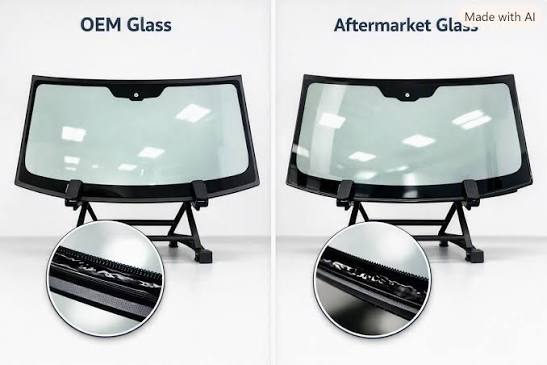
OEM Vs. Aftermarket Windshield Glass: Comparative Analysis
To understand which one is best for your vehicle, it’s important to address the “OEM vs aftermarket windshield glass” analysis so you can make an informed decision.
| Features | OEM Windshield | Aftermarket Windshield |
| Manufacturer | Made to vehicle-maker specs | Made by an independent glass manufacturer |
| Fit | Designed around vehicle specs | Quality & fit vary by manufacturer |
| Cost | More expensive | More budget-friendly |
| Availability | Need to be ordered | Easier to source |
| ADAS Compatibility | Designed around original vehicle specs | Compatibility depends on the specific glass |
| Optical quality | Designed to original specs | Varies by manufacturer |
| Best for | Drivers prioritizing original specs | Drivers looking for a good alternative |
So, what’s the key takeaway?
Do not decide anything based on “price” alone. Check other factors as well and decide what you really want.
Is OEM Glass a Safer Option Than Aftermarket Glass?
This is probably one of the biggest questions most drivers ask in Moses Lake.
And honestly, its answer is not as simple as you think.
OEM = safe
Aftermarket = unsafe
A properly manufactured and installed windshield is extremely important for the safety structure of your vehicle, regardless of who made the glass.
However, another concern is whether the specific glass is right for your vehicle.
It includes:
- Correct dimensions
- Correct curvature
- Proper mounting
- Appropriate glass specifications
- Correct camera or sensor positioning
- Proper installation procedures
Choosing the right glass and having it installed correctly are the two most important factors for your vehicle.
What About the Windshield Fit?
Modern windshields are different. They are not like a simple flat piece of glass. Instead, they are carefully shaped and designed to match the vehicle.
A proper fit helps you ensure the following:
- Correct contact with the adhesive
- Proper alignment
- Correct seating in the vehicle
- Appropriate positioning of cameras and sensors
- Good sealing against water and air
- Proper appearance around the edges
However, a high-quality aftermarket windshield can be properly matched to your vehicle.
Optical Clarity Matters
Sometimes you drive at night and look through a windshield, but something feels off. Right? It’s like objects appear to move differently. That’s where we talk about optical clarity.
Your windshield is part of your normal field of vision. Even small optical imperfections can become annoying when you’re driving, particularly the following:
- At night
- In bright sunlight
- During rain
- On long drives
When looking toward the edges of the windshield
Good-quality replacement glass should provide consistent visibility.
OEM vs. Aftermarket and ADAS
ADAS stands for Advanced Driver Assistance Systems
Now, depending on your vehicle, ADAS technology includes several features such as
- Forward collision warning
- Automatic emergency braking
- Lane departure warning
- Lane-keeping assistance
- Adaptive cruise control
- Traffic-sign recognition
- Pedestrian detection
Remember, windshield replacement can affect the position of cameras, sensors, or other components around the glass.
Does Every Windshield Replacement Require ADAS Calibration?
No. It usually depends on your vehicle and the systems installed.
Well, some vehicles have cameras or sensors that require recalibration after windshield replacement. Requirements usually vary by:
- Vehicle make
- Model
- Year
- Safety-system configuration
- Camera location
- Manufacturer requirements
That’s why professional inspection matters for your vehicle’s protection.
Why is Aftermarket Glass Cheaper than OEM?
That’s another concern of most drivers in Moses Lake. They wonder why there is such a great price difference between both options.
- OEM: $700
- Aftermarket: $450
Most of them think aftermarket is cheap, so they go for it.
OEM glass can cost more because of the following:
- Manufacturer-specific sourcing
- Vehicle-specific specifications
- Brand and supply-chain costs
- Specialized features
- Limited availability
Aftermarket glass may be lower in price, but it doesn’t mean it has better value.
When Does OEM Glass Make More Sense?
OEM is particularly an attractive choice when
- Your vehicle has good ADAS technology.
- The windshield has a head-up display.
- Your vehicle has specialized glass features.
- You want glass matching the original specifications.
- You are concerned about optical quality.
- Your vehicle is newer or particularly high-value.
- You simply prefer original-equipment glass.
For some drivers, the additional cost is worth the peace of mind.
When is Aftermarket Glass a Good Choice?
A quality aftermarket windshield can make sense when:
- The glass is from a reputable manufacturer.
- It is specifically designed for your vehicle.
- Required safety features are supported.
- ADAS compatibility has been confirmed.
- The glass meets applicable safety requirements.
- The installation is performed properly.
- The price difference matters to your budget.
For many everyday vehicles, a properly selected aftermarket windshield can be a practical option.
What Makes an Ideal Windshield Replacement?
At the end of the day, you want your windshield installed properly, which includes:
- Correct glass for your vehicle
- Reliable glass quality
- Proper fit
- Clear optical performance
- Correct handling of cameras and sensors
- Proper adhesive and installation
- ADAS calibration when required
- A technician who understands the vehicle’s requirements
This means there is a lot more important than choosing between OEM and aftermarket glass.
Final Thoughts – OEM Vs Aftermarket Windshield Glass
So, OEM vs. aftermarket windshield glass—which one is right for you?
It depends on your vehicle, its technology, your budget, and what matters most to you.
OEM glass can provide confidence in original specifications, while a quality aftermarket windshield can offer excellent value when it’s properly matched to your vehicle.
The important thing is not to make your decision based on price alone.
At Skaug Bros Auto Glass, the goal is to help you understand your options and choose a windshield replacement that makes sense for your vehicle—not simply sell you the most expensive option.